The Amazon #3: In 1989 writer Steven T. Seagle and artist Tim Sale collaborated on a miniseries about a reporter who goes into the Amazon rainforest tracking the story of a missing logger. This just happens to coincide with a series of attacks on a logging camp attributed to locals by the Tanando, the spirit of the forest. What ensues is a Heart of Darkness-style trip down the river, where the reporter encounters the depths and riches of the Amazon, and finds the truth about his story is more complex than he’d thought.
For a work which is 20 years old, The Amazon feels fresh and current. Sadly, issues of deforestation and colonization are still present, which keeps the book from feeling dated. And while it does brandish its message a bit on the blunt side – the image of logging equipment overrun by foliage being fairly pointed – it still works as an examination of man’s interaction with (and exploitation of) both nature and fellow man.
Seagle uses an interesting and effective narrative device of using the reporter’s notes and story as narration. The contradictions and similarities give a rounded dimension to the action and character and give insight into the self editing that goes into making a story. Sale’s thin line work and use of shadow work well with the script, capturing the simultaneous vast expanse and claustrophobic density of the jungle. His art really brings the story to life, especially in scenes where the narrator interacts with the forest villagers. This book is a rare, if slightly flawed, gem that Dark Horse did justice by revealing.
 Phonogram: The Singles Club #2: The first Phonogram series, Rue Britannia, was brilliant on many levels – not just in the way writer Kieron Gillen seamlessly interwove the worlds of magic and the Britpop movement of the 90s (as well as music in general), but also that it was filled with strong characters and an emotional depth that made the story satisfying regardless of whether you knew the music or not. Or so it seemed; having been– okay, continuing to be a huge Britpop fan, I really have no idea if someone not familiar with the intricacies of British guitar rock circa 93-97 would be lost or not. But Gillen did provide extensive liner notes and commentary in the back, which one would hope would be effective. Then there’s Jamie McKelvie’s art, which is clean and crisp and just about perfect in every way.
The new series, The Singles Club, takes place in – wait for it – a dance club, and chronicles one night from numerous characters’ perspectives. While the core elements of the first series are present – music, magic, hot young Brits running around – this series focuses more on the people involved, and benefits all the more for it.
This issue is probably the most accessible of all Phonograms so far, both in storytelling and subject matter. This issue introduces us to Marc, a.k.a. Marquis, who along with being young and hip is just (barely) getting over some girl. He and a pal end up in the club, and all is fine, until the Cursed Song comes on, and he comes face to face with the image/spirit of the vibrant, cute, Eastern European girl who broke his heart. Or so it seems, although his reminiscences seem to imply differently.
Everyone’s in top form here. Gillen’s dialogue is just great – from the (unnamed) ex’s accent (“They are nothing but bullshits with bad record collections” has officially entered the lexicon) to Marc’s pal Lloyd’s attempts at pop deconstructionism – and the interactions are revealing in what is and isn’t said. McKelvie’s art is stunning in this book, full of energy and motion, and aided greatly by Matthew Wilson’s colors. All around, this is one of the best books on the stands, and definitely earns the coveted

 The Umbrella Academy: Dallas #6: The second series featuring Gerard Way and Gabriel Bá’s dysfunctional family/super-team ends with a bang – several, actually. Picking up where the first series left off, Dallas finds the team in a collective state of despondency after one of their own tried to destroy the world. Each member is pulled – sometimes dragged – out of their individual states when a pair of sugar-addicted assassins with oversized cartoon-character masks try to track down UA member Number Five, whose future/past self (oi, time travel) is supposed to assassinate John F. Kennedy. Along the way, team member Séance meets a cowboy-on-horseback God, team leader Space Boy fights monsters during the Vietnam War, and the Earth blows up. And we learn the secret of one diner’s amazing apple pie.
With just his second series Way has proven to be a consistently talented and flexible writer, able to balance the sci-fi/fantastic elements with genuine emotion and a healthy sense of the absurd. Bá’s art suits the writing well, blending a Mike Mignloa-esque cartoonishness with a strong storytelling ability. While this series possesses a bit more of a downbeat vibe than the first, it’s a fun read, and bodes well for future installments.
 The Unwritten #1: Tommy Taylor is a ridiculously popular series of books about a teenage wizard. Tom Taylor is the man who, as a boy, was the inspiration for the books. Or so the story goes. Except that a woman shows up at a press conference with evidence to the contrary. And one of Tommy Taylor’s nemeses shows up to take out Tom Taylor. And there’s still the mystery of why Taylor’s father, the author of the Tommy Taylor series, disappeared. And what does this have to do with a map?
Writer Mike Carey and artist Peter Gross have managed to interweave geek/celebrity obsession, the fantasy/reality overlap, the nature of stories, and a straight-up mystery in what is one of Vertigo’s best offerings in a while. The high concept of the central question – who is Tom Taylor, really? – is buoyed by various real world aspects, as shown by the IMs surrounding a life-feed execution of Tom Taylor by a real-life version of Tommy Taylor’s enemy Count Ambrosio.
It’s hinted that the true scope of the book will be far greater than just one character’s real identity, but even without that the book shows enough promise to warrant further reading. And the first issue’s only a buck, so you can’t go wrong.
I think that catches us up, and just in time for New Comic Day! Time to get back to my experiments of making compost out of all those old Youngblood issues.

 Final Crisis Aftermath: Escape #1: Have you ever wondered what it would be like if Franz Kafka and James Joyce co-wrote an episode of The Prisoner using characters from the DC Universe? “Who hasn’t?” you say. Well, now this dream has finally been realized, thanks to FCA:E. The issue begins with former secret agent Nemesis awakening in an undesignated prison cell, surrounded by three women with bobs and mod dresses offering to be his friend. Now, while Your Humble Blogger would call this Heaven, Nemesis is obviously not happy with the situation, especially given the distinct lack of humanity present in his “friends.” His attempted escape leads through an unmarked hallway where he encounters a very ominous looking Mr. Terrific. Then Nemesis runs across Count Vertigo... that's where the acid kicks in*.
 The Punisher: Frank Castle #70: Any issue of the Punisher that opens with a Mexican stand-off between FBI agents, gang bangers and the Russian Mafia is pretty much an automatic win. Crime novelist Duane Swierczynski has delivered the best post-Garth Ennis Punisher storyline so far with this conclusion to his “Six Hours to Kill” arc. For those needing a refresher, the Punisher follows a ring of criminals to Philadelphia, where he is kidnapped and injected with a drug he’s told will kill him in six hours; for the antidote, he merely has to kill a particular mob target. This being the Punisher, he rejects the deal, and a night of mayhem and bloodshed ensues. Swierczynski succeeds in balancing the humor, twists, and straight-up carnage that made this one of the best books for misanthropic thrills. If you’ve missed the previous issues then catch the trade (no doubt coming soon).
 The Walking Dead #61: Seriously, if you’re not reading this book, just start already.


 Daredevil: Noir #2: Definitely one of the best books this week. Picking up from the first issue: Tensions between the rival gang bosses are building, and our characters are getting ready for the impending war. Meanwhile, Daredevil/Matt discovers that gang boss Orville Halloran was the man who killed his father, altering his motivation greatly. And the mysteries of the Bull’s Eye Killer and Eliza, Halloran’s moll deepen. The minor complaints I had with the writing in the first issue are gone; Alexander Irvine’s script is taut, and not only plays the split between the Matt Murdoch and Daredevil identities well, but takes the “overwhelmed senses” exposition from last issue and shows how it plays into DD’s heroics. Tom Coker’s art is still top notch, especially in a rainy sequence at the end of the book. This book manages to merge the Shadow-style pulp with the straight crime stories of Mickey Spillaine, and doesn’t come off in any way cliché.
 Destroyer #2: Still brilliant. With the premise set up, writer Robert Kirkman goes right into the meat of the story, focusing on Destroyer’s search for his arch nemesis Scar, while trying to protect his family from the inevitable backlash that comes with deciding to kill all the super villains before he dies. Unfortunately, he finds his efforts aren’t as effective as he thought.
 Final Crisis Aftermath: Run! #1: As much of a mindfudge as Final Crisis was, it was still an Event, and as such requires its share of spin-off series. What else are superhero comics about, right? FCA:R is the first of these, and focuses on Mike Miller, a.k.a. the Human Flame, a third-rate super villain whose claim to fame in FC is that Martian Manhunter was killed on his behalf, and he was the first villain to fall victim to the Anti-Life Equation. Now that the Crisis is over, he’s fresh out of a coma and trying to high-tail it out of town before the cops/super-heroes/pissed off super-villains get him. In the course of doing so, and with the aid of a stoner friend, he incurs the wrath of the Kyrgyzstani mob. Madcap hi-jinks ensue.
 The Flash: Rebirth #2: Barry Allen, the Silver Age Flash, is officially back from the dead. For readers under 40 this may not be the “ZOMG massive awesome event” that DC editor-in-chief Dan DiDio hopes it to be, but thanks to writer Geoff Johns it at least makes for decent reading.
 New Mutants #1: In the ‘80s, the New Mutants was one of the most distinct X- books, thanks mainly to artist
  Power Girl#1: Power Girl has always been an odd duck of a character. Created as a cousin of the Golden Age Super Man, through all the continuity revamps at DC her back story has changed almost as often as Wolverine’s, and as a character she really wasn’t much more than a second-rate Supergirl. With this issue writers Justin Gray and Jimmy Palmiotti try to reconcile that and make her a character in her own right. In the course of this we see P.G., aka Karen Starr, try to establish a new life, having been separated from her birth universe. In the middle of this, alien robots show up in New York City, and start smashing the place up while emitting rays causing mass hysteria and violence in the streets. And then the Ultra-Humanite, a super-intelligent gorilla with telepathy, makes his entrance.
 Batman: Battle for the Cowl – The Underground #1: Seriously, how many subtitles can these books have? Anyway, this is a one-shot leading up to Battle for the Cowl #3 and the Gotham City Sirens series (not to be confused with the
  Captain America: Theater of War – A Brother in Arms: This issue continues the line of Theater of War one-shots, featuring the original Cap in various wartime stories. AbiA takes place in Germany, 1945, where Cap and a group of Army Rangers are shot down behind enemy lines. In the process of fighting for survival they take a German soldier prisoner – much to the disgust of the group’s corporal, who’d as soon shoot him and be done. As the story progresses, the enemies find their common humanity, especially when faced with the local SS officer, who has no use for common German Army soldiers.
 Final Crisis: Legion of Three Worlds #4: I’ll fully admit that when Final Crisis was in full swing, this was one of the many tie-ins I ignored, figuring that a) anything not written by Grant Morrison would probably be incidental, and b) I’ve never been a huge Legion of Super-Heroes fan. Well here we are five months after the main FC ended, and FC:Lo3W is still going, mainly I think for one reason: who’s going to tell legendary artist George Pérez he needs to hurry up? Add to that the fact that he probably crams the most panels per page of any book currently on the stands and yeah, you’re going to have to just forget about that monthly deadline.
 Justice Society of America #26: With this issue, writer Geoff Johns and penciller Dale Eaglesham end their run on JSA, and they go out not with a bang nor whimper, but a party. A birthday party that is, for teenage member Stargirl, which allows Johns to really focus on the personal interactions and human dimension of the team while avoiding having to insert any mandatory fight scenes. That’s right, not a single punch is thrown in the entire issue, giving one of those rare fun comics we see all too few of out of the Big Two any more. And of course, Alex Ross’ covers (count ‘em, three for this issue!) are simply amazing. Not a bad way to go out.
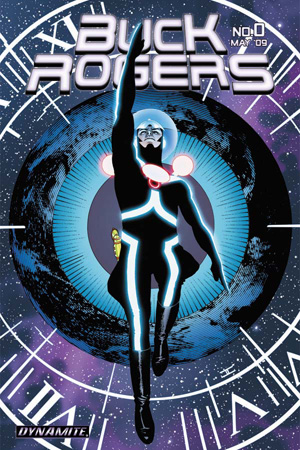 Buck Rogers #0
 Detective Comics #853
 Ignition City #2
 Skrull Kill Krew #1
 Green Lantern Corps # 35: At Brian’s behest I started checking out the Green Lantern books – even though I fully admit having Event Fatigue after Final Crisis (which, on second reading, isn’t as bad as people seem to think) – and both GL series are gearing up for the Blackest Night storyline. But given the high quality of both this book and the main Green Lantern series, I may just have to change all that.
 Wolverine Noir #1: We had X-Men: Noir, so really, could a Noir version of Wolverine be far behind (I mean, it’s not like Marvel would have any reason to push the character about this time of year, right?). That said, much like last week’s Daredevil: Noir, this book holds up to the concept’s promise.
 The Strange Adventures of H.P. Lovecraft #1: As someone who’s read more than his fair share of Lovecraft’s works, I admit to going into this book with a little trepidation. After all, you can count how many good movies have been made from Howard Phillips’ books on one tentacle. Thankfully, the TSAoHPL manages to be a highly entertaining read.
 Batman: Battle for the Cowl #2
 Daredevil: Noir #1
 Dark Reign: Hawkeye #1
 Ignition City #1
 Destroyer #1